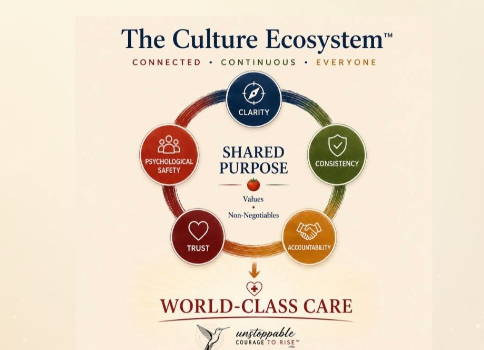
We are proud to re-post this message from our colleague, Mila Sprouse, EdD, MSN, RN, CCRN, NE-BC from her LinkedIn post
Her thoughts and insights are timely as DNP Inc./ADPN/JADPN strive to build an ecosystem of collaboration. Please read on…..
When leaders talk about culture transformation, the conversation often begins with initiatives. We create engagement plans, launch recognition programs, establish committees, conduct leader rounding, and develop communication strategies. Each of these efforts has value, and many are necessary. However, none of them, on their own, transforms culture. Culture transformation is not the result of a single initiative; it is the result of intentionally creating an environment where people are able to think differently, behave differently, and ultimately believe differently about the organization they serve.
Over the years, I have come to believe that culture transformation begins long before engagement scores improve or quality metrics move in the right direction. It begins with leadership clarity. People need to know what their leaders stand for. They need to understand the values that will never be compromised, the behaviors that will always be expected, and the standards that will remain consistent regardless of circumstances. These become a leader’s non-negotiables. Without that clarity, culture becomes dependent upon personalities and individual preferences rather than shared expectations.
Clarity alone, however, does not create trust. Caregivers are remarkably perceptive. They do not simply listen to what leaders say; they observe what leaders consistently do. They watch how difficult conversations are handled, whether accountability applies equally to everyone, whether disrespect is addressed regardless of position, and whether patient safety remains the priority even when operational pressures mount. Every decision, every conversation, and every response sends a signal about what the organization truly values. Those signals accumulate over time, becoming the foundation upon which trust is either built or quietly eroded.
This is why I often say that culture transformation is less about changing people and more about creating the conditions where people feel safe enough to bring their best selves to work. When expectations are clear, actions are consistent, and accountability is fair, caregivers begin to develop confidence in their leaders. Confidence gradually becomes trust. Trust creates psychological safety. Psychological safety encourages people to speak up, ask questions, challenge unsafe practices, support one another, and continuously improve. What appears from the outside to be a dramatic culture shift is, in reality, the natural outcome of hundreds of consistent leadership behaviors repeated over time.
Looking back, this understanding also explains why engagement and organizational commitment are so closely connected. People do not become committed because they complete an engagement survey or attend another organizational initiative. Commitment develops because they repeatedly experience an environment where leaders are clear, consistent, fair, and trustworthy. Engagement is often the visible expression of something much deeper: the confidence that this organization will live up to what it says it believes. When trust deepens, commitment follows. When trust erodes, engagement eventually declines as well. My doctoral research explored these very relationships, and it reinforced my belief that organizational commitment is cultivated through lived experiences rather than isolated initiatives.
As I recently read an article by Melora Heffron and Jeff Doucette on governing social capital, I found myself nodding throughout much of their work because it articulated something I have experienced throughout my own leadership journey. They wrote, “Culture can no longer remain a loosely defined aspiration. If communication, trust, and relational leadership practices are the conditions that generate social capital, and social capital influences resilience, knowledge transfer, and care quality, then those conditions must be actively governed. Social capital is not simply something leaders encourage; it is something they help build, sustain, and protect.” I believe they capture an essential truth. Trust, respect, communication, and psychological safety are not simply desirable cultural characteristics; they are leadership responsibilities that require intentional stewardship.
Where I would build upon their thought is this: before leaders can govern social capital, they must first create the environment where it can grow. Social capital is not produced by a policy or a strategic plan. It develops because leaders consistently demonstrate clarity in expectations, consistency in actions, fairness in accountability, and authenticity in their relationships. These behaviors become the fertile ground where trust takes root. Without those conditions, culture initiatives often become temporary programs rather than lasting transformation.
This perspective has also changed the way I think about leadership visibility. Visibility is often measured by physical presence, and physical presence matters. There is tremendous value in leaders being present where care is delivered. Walking the units, asking questions, listening without an agenda, celebrating successes, and understanding the realities of frontline work communicates respect in ways that cannot be replicated through emails or dashboards. Physical rounding reminds caregivers that they are seen, heard, and valued. It creates moments of connection that strengthen relationships and reinforces that leadership is genuinely interested in understanding the work.
Yet physical rounding alone cannot answer the question that every caregiver is ultimately asking: Can I trust this organization?
For leaders responsible for thousands of caregivers across multiple hospitals, it is simply impossible to have meaningful personal interactions with everyone on a regular basis. If trust depends solely upon physical encounters with senior leaders, then most caregivers will never experience it. That is why I have come to believe that physical rounding is the icing on the cake, not the cake itself. The cake is built through consistency. Leaders become visible when caregivers know what they stand for, believe they will respond consistently regardless of circumstances, and trust that the same expectations apply to everyone. In that sense, visibility is not defined by proximity but by predictability. Leaders become visible because their values are consistently experienced, even when they are not physically present.
Perhaps this is why I have increasingly thought about culture not as a destination but as an ecosystem. Ecosystems do not flourish because of one isolated event. They thrive because countless interconnected conditions support one another. The same is true for organizations. Clarity supports consistency. Consistency builds trust. Trust strengthens psychological safety. Psychological safety encourages people to speak up without fear, collaborate across disciplines, learn from mistakes, innovate, and continuously improve. Those behaviors strengthen engagement, deepen organizational commitment, improve resilience, accelerate knowledge transfer, and ultimately lead to better care for our patients. Every element reinforces the next until culture itself begins to change. It is not one initiative that transforms an organization; it is the interconnected system of leadership behaviors that collectively creates the capacity for transformation.
Culture transformation, however, is never finished. Just as trust is built through repeated experiences, it can also be weakened through repeated inconsistencies. Culture rarely collapses because of one catastrophic event. More often, it slowly erodes through a thousand paper cuts. A promise not kept. An inconsistency left unaddressed. Disrespect that goes unchecked. Accountability applied differently depending upon the individual. Communication that becomes less transparent. Each incident may seem insignificant in isolation, but together they quietly weaken the trust leaders have worked so hard to build.
The opposite is equally true. Culture is strengthened through thousands of small moments of integrity. Every time leaders honor their non-negotiables, communicate with clarity, follow through on commitments, and model accountability, they reinforce the ecosystem that allows trust to flourish. Over time, those moments become habits. Those habits become norms. Those norms become culture. The ecosystem becomes stronger, relationships become deeper, and people become more willing to invest not only in their work but also in one another.
I have often said that culture is everyone’s responsibility, and I believe that more today than ever before. Leaders certainly have an outsized influence because they establish expectations and model behaviors, but culture ultimately belongs to every caregiver. Every interaction either strengthens or weakens the ecosystem. Every conversation either builds trust or diminishes it. Every decision either reinforces our shared values or quietly compromises them. Culture is not owned by one leader or one department. It is co-created every day by every person who walks through our doors.
Culture, therefore, is not what leaders hope people experience. Culture is what people repeatedly experience when leaders are not in the room. It is reflected in the decisions they make, the conversations they have, the way they treat one another, and the confidence they have that the organization will do the right thing even when no senior leader is present.
Culture transformation is not something leaders announce. It is something they cultivate every single day through intentional stewardship. It is not sustained by grand initiatives but by thousands of leadership behaviors that create the conditions where trust can grow, accountability is fair, expectations are clear, and every caregiver knows their voice matters. When those conditions are consistently nurtured over time, culture does not merely improve. It transforms.
And perhaps that is the most important lesson of all. Culture transformation is not an initiative. It is the intentional stewardship of a culture ecosystem.

Dr. Mila Sprouse, EdD, MSN, RN, CCRN, NE-BC
Regional Service Area Chief Nursing Officer, Amazon #1 Bestselling Author, Founder of Unstoppable Courage to Rise: Leading with Courage, Culture & Executive Presence. She lives in Seattle, Washington