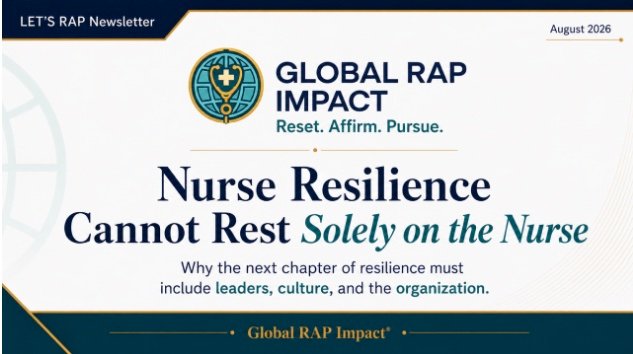
This article was posted on LinkedIn by our colleague, Jordia Batchelor, DNP, APRN, FNP-BC. Read more HERE.
For years, conversations about nurse resilience have often centered on what the individual nurse should do.
Breathe more deeply.
Practice gratitude.
Set stronger boundaries.
Become more adaptable.
Learn how to manage stress.
These practices matter. I believe deeply in the power of a pause, the steadiness of intentional breathwork, and the importance of reconnecting with who we are beneath the weight of our roles.
But lately, I have been sitting with a deeper truth:
We cannot continue asking nurses to become more resilient while leaving the environments that are exhausting them unchanged.
A nurse can begin the shift grounded, focused, and emotionally prepared.
Then the assignment changes.
The call light keeps sounding.
A family is waiting for answers.
A colleague needs support.
Documentation continues to accumulate.
Lunch is delayed, again.
By the end of the day, the body may still be moving, but internally, something has tightened. The shoulders feel heavy. The jaw is clenched. The mind is still replaying the shift long after the badge has been removed.
That experience is not always a failure of personal resilience.
Sometimes it is the predictable response of a human being working within a system that has asked too much for too long.
Individual resilience matters, but it is not the entire solution
Nurses need practical tools that help them regulate stress, protect their identity, strengthen confidence, and pursue their purpose without abandoning themselves.
That conviction remains at the heart of the RAP Framework™:
Reset. Affirm. Pursue.
But resilience cannot become another responsibility placed entirely on the shoulders of the nurse.
It cannot be reduced to:
“Here is a wellness app.”
“Remember to practice self-care.”
“Try to develop a more positive mindset.”
Not when the deeper conditions influencing well-being, psychological safety, professional confidence, belonging, workload, and retention remain unexamined.
We must be willing to look beyond the individual and ask:
What is happening within the environment?
Do nurses feel safe enough to speak honestly?
Are new nurses being supported as they move from education into practice?
Do leaders recognize the early signs of emotional overload?
Are teams being given practical tools before stress becomes disengagement?
Are organizations measuring what truly matters, or only responding after people begin to leave?
These are not small questions.
They are leadership questions.
They are culture questions.
And increasingly, they are workforce sustainability questions.
The next chapter of resilience must include the organization
Over the past several weeks, much of my work behind the scenes has centered on this very issue.
I have been thinking more deeply about what it takes to move resilience beyond a one-time workshop or inspirational moment and into the everyday experience of nurses.
That means examining how support is introduced, experienced, measured, and sustained.
It means creating space for the nurse’s voice while also helping leaders understand what that voice is revealing.
It means building approaches that are compassionate enough to honor the human experience and structured enough to support meaningful organizational action.
This is where my clinical experience, doctoral preparation, work in palliative care, and journey as the creator of the RAP Framework™ continue to converge.
At the bedside, I have learned that what appears on the surface rarely tells the entire story.
A tense conversation may be carrying fear.
Withdrawal may be carrying exhaustion.
Frustration may be carrying grief.
Silence may be carrying a need that has not yet felt safe enough to speak.
The same is often true within healthcare teams.
What we label as disengagement may be depletion.
What we interpret as resistance may be a lack of trust.
What looks like poor confidence may be the result of repeated exposure to environments where someone has never felt safe enough to learn out loud.
When leaders pause long enough to listen beneath the surface, they gain access to information that policies and productivity reports alone cannot provide.
Regulation is not only a personal skill
One of the principles I continue returning to is this:
Regulation is a leadership skill.
A regulated leader creates space before reacting.
A regulated leader can remain present during discomfort.
A regulated leader listens without immediately becoming defensive.
A regulated leader understands that emotional steadiness influences the entire room.
This does not mean leaders must be perfect or unaffected.
It means they become more aware of the atmosphere they are helping create.
Nurses are constantly reading the environment.
They notice the tone of the morning huddle.
They feel whether questions are welcomed or quietly punished.
They know which leaders make them feel supported and which ones make their nervous systems tighten before a conversation even begins.
Culture is not only written in a mission statement.
It is felt in the body.
It is heard in the way correction is delivered.
It is seen in what happens after someone admits they are struggling.
It is experienced in whether support is offered consistently or only after a crisis.
From surviving the system to helping transform it
I do not want nurses merely surviving difficult environments while being praised for how much they can endure.
I want them to thrive.
I want new nurses to enter the profession with support that strengthens both competence and confidence.
I want experienced nurses to feel that their wisdom is valued without their humanity being overlooked.
I want leaders to have practical ways to recognize what their teams need before burnout becomes resignation.
And I want healthcare organizations to see resilience not as a personal luxury, but as a strategic part of healthy culture, workforce well-being, and sustainable impact.
That vision has been shaping the work I am building through Global RAP Impact®️.
Some of it is still being developed carefully and intentionally.
Frameworks are being refined, tools are being strengthened, and pathways are being created to help nursing schools, healthcare leaders, and organizations better understand and respond to the lived experiences of nurses.
I am not ready to reveal every detail yet.
But I can say this:
The work is expanding.
Not away from the nurse, but around the nurse.
Because supporting nurses requires more than teaching them how to carry the weight.
It also requires examining why the weight has become so heavy.
A shared responsibility
Personal resilience will always matter.
There will always be value in the quiet reset before entering the unit.
There will always be power in affirming who you are when a difficult moment makes you question yourself.
There will always be purpose in taking one grounded step forward.
But nurses should not have to do this work alone.
Resilience must become a shared responsibility.
Nurses need tools.
Leaders need awareness.
Teams need psychological safety.
Organizations need honest insight.
And healthcare needs cultures where people are not celebrated only for enduring, but supported in becoming well.
As we move through August, this is the question I am carrying:
What would change if we stopped treating nurse resilience as an individual assignment and began approaching it as an organizational commitment?
Perhaps that is where the next chapter begins.
Not with asking nurses to become stronger in isolation.
But with building environments where they no longer have to spend so much of their strength simply trying to survive.

Dr. Jordia Batchelor, DNP, APRN, FNP-BC
Palliative Care Nurse Practitioner
Nurse Resilience Expert
Founder, Global RAP Impact®️
Creator of the RAP Framework™